
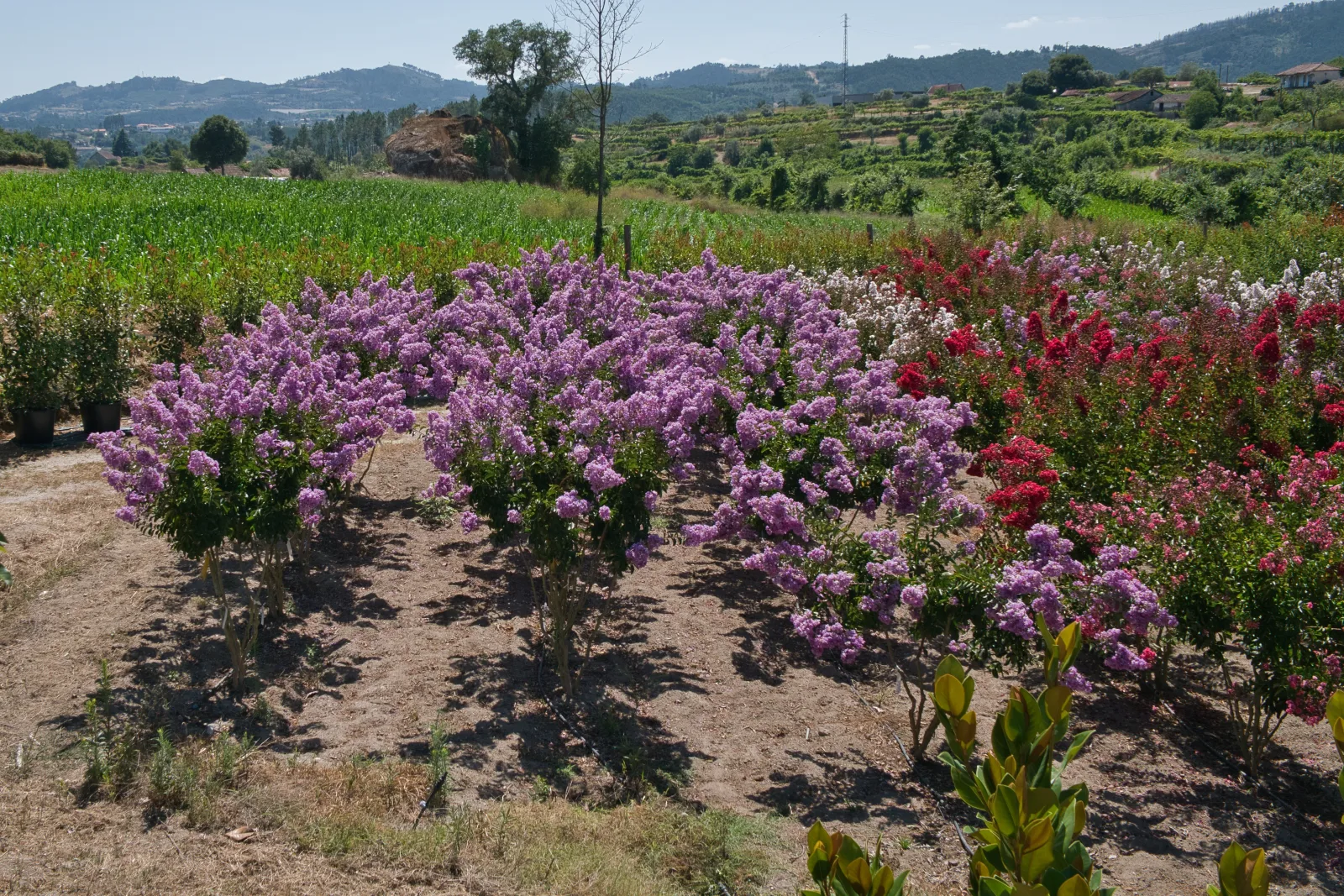
Commercial use of multi-stem trees places different demands than a residential garden: low maintenance, resistance to harsh conditions, immediate visual impact and aesthetic consistency all year round. In this guide we bring together the species that best meet these criteria, with specific recommendations by context.
What makes a multi-stem suitable for commercial use
A commercial space has constraints that a private garden rarely faces with the same intensity. Before selecting the species, it is essential to assess:
- Available maintenance team. Most commercial spaces have basic maintenance: watering, clearing fallen leaves, occasional formative pruning. Species requiring specialised technical pruning or frequent phytosanitary treatments should be avoided.
- Site conditions. Impermeable paving, heat reflected off façades, partial shade from buildings and compacted soils are common conditions in urban and commercial settings. The species must tolerate them.
- Year-round visual presence. Unlike a residential garden, which can go through periods of lesser interest, a commercial space (especially reception areas, entrances or terraces) must always look presentable. Evergreen species or those with interesting winter structure have an advantage.
- Scale of the project. In large condominiums, business parks or hotels, volumes can be significant. Availability of stock in quantity and uniformity of specimens (same size, same habit, same number of trunks) are critical factors.
Recommendations by type of commercial space
Entrances and reception areas
Entrances are the first point of contact with a company's or hotel's image. In this context, the multi-stem is the element that most effectively communicates care, investment and quality, especially when framed by quality paving and night-time lighting.
Recommended species:
- Lagerstroemia indica: Lush summer bloom in pink, white or purple, beautifully striped bark and intensely coloured autumn foliage. One of the species with the greatest visual spectacle concentrated in a single plant. Tolerates urban heat well and requires minimal maintenance once established.
- Acer palmatum: Refined silhouette and exceptional autumn colour. Conveys sophistication and attention to detail. Ideal for design-hotel entrances, corporate headquarters and high-end condominiums.
Interior courtyards and office gardens
Spaces used daily by staff: lunch areas, break gardens, outdoor meeting zones. Here the plant must perform all year round and be visually appealing at eye level, since people will be close to it frequently.
Recommended species:
- Osmanthus heterophyllus: Evergreen with dense, glossy foliage and discreetly fragrant bloom. Keeps volume and presence all year round without ever looking bare, making it ideal for constantly used spaces. Tolerates partial shade, an advantage in building courtyards.
- Acer palmatum (red-leafed varieties): The permanent colour of the foliage in some varieties guarantees visual impact throughout the growing season, without depending on bloom or autumn colouring.
Business parks and office condominiums
Larger spaces where the multi-stem is used as a structuring element in broader compositions, usually combined with lawns, ground-cover planting and street furniture. Here resistance, stock uniformity and low maintenance are the dominant criteria.
Recommended species:
- Liquidambar styraciflua: Dense canopy that provides quality shade in summer and spectacular colour in autumn. One of the few species able to fulfil two functions at once (effective shading and an ornamental focal point), making it cost-efficient per unit of impact.
- Pinus sylvestris: For projects requiring permanent sculptural presence and visual consistency all year round, regardless of season. The umbrella-shaped canopy and orange bark make it unmistakable. Requires generous space but needs no specific maintenance once established.
Hotels, restaurants and leisure spaces
In these contexts, the multi-stem is simultaneously a landscaping element and a branding asset: it contributes to the guest experience and to the space's visual identity. The selection criteria are more demanding aesthetically here, and the authenticity of each specimen (form, structure, bark texture) is an asset in itself.
Recommended species:
- Lagerstroemia indica: The bloom coincides with the busiest season (summer) and the multicoloured bark has high photographic appeal, a relevant factor in contexts where social-media presence and visual reviews matter.
- Acer palmatum: Conveys exclusivity and attention to detail. Often used in boutique hotels and landmark restaurants as a singular compositional element.
Quick reference table
| Species | Evergreen | Maintenance | Best context |
|---|---|---|---|
| Lagerstroemia indica | No | Low | Entrances, hotels, restaurants |
| Osmanthus heterophyllus | Yes | Very low | Interior courtyards, office gardens |
| Liquidambar styraciflua | No | Low | Parks, shading areas |
| Acer palmatum | No | Medium | Premium entrances, intimate-scale courtyards |
| Pinus sylvestris | Yes | Very low | Parks, large outdoor spaces |
Stock uniformity: a commercial requirement often underestimated
When a project requires twenty or thirty specimens of the same species at the same size, uniformity is critical. A residential garden tolerates variation: two Acer palmatum specimens of slightly different heights can coexist without issue. In a commercial composition with dozens of plants in a row or group, differences in habit between specimens are immediately visible and compromise the quality of the result.
Âmbarplant has direct access to production across the European network (Spain, the Netherlands and Germany), which allows us to guarantee uniformity at volumes the domestic market can rarely supply from a single source. For larger projects, we recommend early contact to reserve a batch.
When to order ahead
The multi-stem is not a plant you order the week of planting. The best sizes are the first to sell out, and restocking with the same uniformity can take a season or more. As a practical rule:
- Projects above 10 specimens: check availability at least 60 days in advance.
- Projects above 30 specimens or with larger sizes: start contact 3 to 6 months in advance to guarantee a reserved batch.
- Projects with a defined opening or client-handover date: share that date at the first point of contact so we can manage logistics with margin.
Have a commercial project in hand?
Send us the list of species, sizes and quantities. We respond with available stock, equivalent options and a value proposal on the same business day.
Request a quote View catalogue